Ash and Iron
Chapter 2
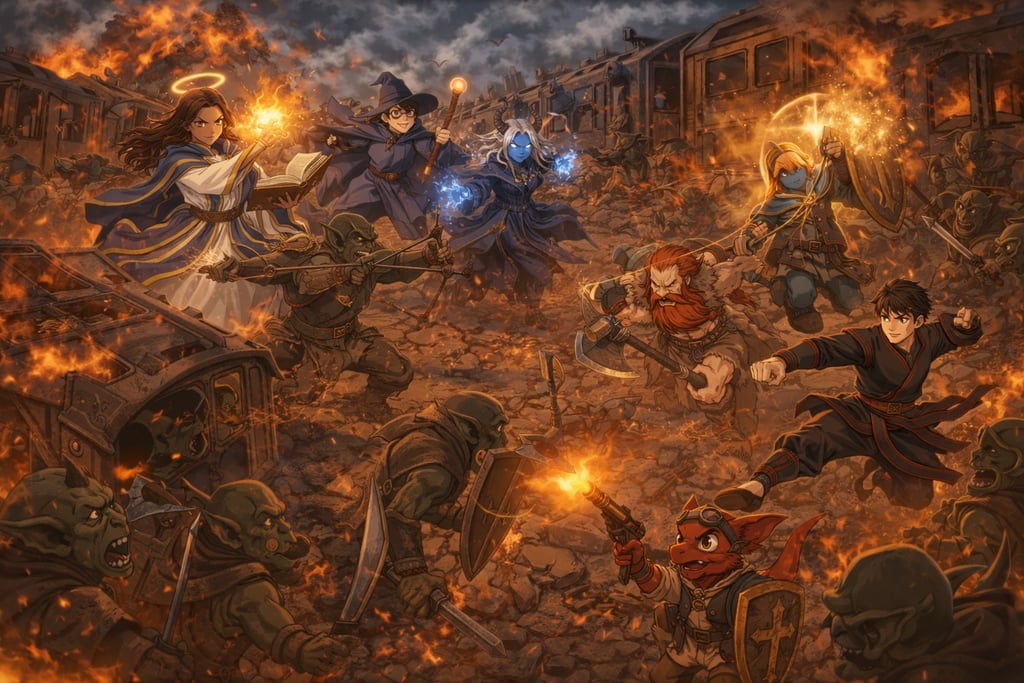

The forest giant mother, battered but alive, clutched her child close. Though her breath still came ragged and her wounds had not fully healed, she managed a soft, grateful smile, directed at Ozzy. No words were spoken. She simply nodded, a deep, earthbound gesture of thanks, then turned away. With her child leaning against her side, the two disappeared into the Virewood, swallowed by trees and mist.
The Ash Dogs lingered only a moment longer.
They searched the goblin camp in practiced silence, rifling through broken crates and trampled tents. Among the loot, they found several Gomatian rifles, a small sack of gold, and most notably, a bag of holding—its stitching frayed, its magic intact. With the stolen supplies secured, they returned to the rail line.
The wreck was just as they had left it. Twisted steel. Burned wood. Ash. Silence. They searched for survivors. Looked under broken beams, pried open splintered doors. But there were no survivors. The group stood among the ruins for a long time. Then, without speaking, they turned east. On the second day of walking the trail east wound along the edge of Lake Noruun, its surface glinting in the evening sun, and there, rising from the lake like a fortress on an island, stood Awayhla.
A bridge stretched from the mainland to the island city, its stone arches strong and wide enough for carts, soldiers, and steam carriages. The Ash Dogs crossed on foot, their boots echoing against sun-warmed stone. Beneath them, the water flowed dark and deep. Steamships puffed smoke from iron stacks as they ferried cargo and soldiers to the docks.
Awayhla was alive with invention. Within its whitewashed walls, artificers shouted across bustling plazas, hawking devices and elemental tools. Steam hissed from carts, gears turned on rooftop weather vanes, and street lamps pulsed faintly with embedded Aqualin stones. The air carried a mix of spices, coal smoke, and lake wind.
The Ash Dogs found lodging at The Silver Goose, a clean and modest inn nestled near the city’s center. Its sign, a carved goose head fitted with a brass honker, gave a wheezing squawk every time someone entered. The beds were warm. The food was hot and better than they had expected. It was nice to have a real bed, they all slept well that night.
The next morning, they headed into the mercahnt quarter in hopes of selling the rifles. The merchant quarter of Awayhla was all grit and industry, a warren of uneven stone alleys, open-air forges, brass-piped storefronts, and the constant clatter of invention. Sparks flew from workshop windows. Iron shutters clanged. Steam hissed from vents that poked from rooftops like metal weeds. The smell of oil and hot metal hung thick in the air.
Artificers in soot-streaked aprons bartered loudly with hawkers over enchanted copper wire, while clockwork birds fluttered and sputtered above signs advertising “Auto-Quills” and “Self-Folding Laundry Arms.” Every corner held the scent of competition, the scrape of progress.
Eventually they found a local shop called Master Metal, a forge known for quality weapons and black powder gear. It was run by a towering goliath named Getterix. The interior of Master Metal was a hot, smoky shrine to flame and steel. Sparks danced in the air. The steady rhythm of hammer on anvil echoed like a heartbeat. In the far corner, runes glowed along the edges of a forge-press, cycling through heat levels as molten iron was poured into a mold.
Behind a workbench stood a goliath with shoulders like a wall and a face carved from granite. His arms were covered in old burn scars, and his braided hair was streaked with soot. He looked up from his work as the Ash Dogs stepped inside. Getterix squinted at them for a moment, then leaned on the bench.
“Don’t get many of your kind in here,” he rumbled.
Uurgnok stepped forward, rifle slung across his back. “What, dwarves or misfits with singed eyebrows?”
Getterix snorted. “Either. Both.”
Uurgnok unslung the rifle and set it on the counter with a clunk. “We pulled this from a goblin camp a day east of here. Thought you might be interested.”
Getterix reached out and picked it up with surprising delicacy for his size. He turned it over, eyes narrowing. He ran a thumb along the barrel, checking the balance, inspecting the lack of markings.
“No maker’s stamp,” he said.
“Aye,” Uurgnok replied. “We thought it was odd too. Goblins had a few of them. Didn’t know they’d taken to quality Gomatian gear.”
Getterix gave a grunt and set the rifle down carefully. “This isn’t just quality. This is military. Your goblins seemed to have scavenged some contraband.”
“Well they are ours now.” Uurgnok folded his arms. “Are you interested in buying them? You could even put your own stamp on them”
Getterix looked at him for a moment, as if weighing something. Then he leaned in slightly and lowered his voice.
“There’s a man, Matreus. Works with the Senate, but he’s got his fingers in things the official orders don’t touch. Word is, he has been looking to buy some rifles, perhaps some weren’t stamped, for discretion.” He tapped the rifle. “Like this one.”
Uurgnok arched a brow. “And what’s he want with unstamped rifles?”
Getterix shrugged. “Not my business. And I like it that way.”
“Fair enough,” Uurgnok said. He reached for the rifle but paused. “So you’re not buying?”
Getterix shook his head. “Not a chance. Anyone selling this kind of steel ends up in chains. Or worse. You want to offload that gear, I suggest you talk with Matreus.”
He gave Uurgnok a long, meaningful look. “And if you do? Be careful. Men like Matreus don’t give without asking for more later.”
Uurgnok gave a crooked grin. “They can ask all they want, if the gold is good I might even say yes.”
He slung the rifle back over his shoulder and turned. The Ash Dogs followed him out into the street.
“Guess we’re paying this Matreus a visit,” he muttered.
The Ash Dogs were again out in the bustling and clanging of the merchant quarter. An artificer was showing off some metal contraption when a spring let go and pieces of metal dropped to the ground.
“Feels like you could lose an eye just walking through here,” Donnie muttered, eyeing a brass golem dragging a cart overloaded with scrap.
“We’re all losing something in this city,” Ryn replied, her voice dry. As the Ash Dogs turned onto Ravel Street, the scenery began to shift. The buildings grew taller—less slapped-together and more intentionally constructed. Soot-stained brick gave way to smooth grey stone, and the chaotic chorus of hammering and shouting softened into the quieter hum of wealth. The pipes overhead became polished and symmetrically aligned, feeding into public boilers and runed lanterns that glowed a steady amber even in daylight.
The air smelled cleaner. More citrus than coal.
Guards in polished cuirasses patrolled the intersections, their blue sashes marked with Awayhla’s sigil—a silver gear overlaid with a four-pointed star. They watched the Ash Dogs pass, noting the mud on their boots and the weapons at their hips.
Uurgnok grunted. “City guards always look at us like we tracked dung through their temple.”
“To be fair,” said Ace, “we probably did.”
By the time they crossed into the noble quarter, the cobbled streets had become broad, tiled avenues with trimmed hedges and gently sloping trees lining the walks. A shallow canal ran alongside the main road, fed by a series of intricate aqueducts that pulsed with faint bluish light—Aqualin magic, no doubt, keeping the city’s heart cool and the fountains flowing.
The houses here were tall and stately, adorned with balconies and curved glass windows. Where the merchant quarter had shouted for attention, these homes spoke in low, confident tones of old money and quiet influence. Carriages drifted past on silent wheels, pulled by well-groomed steeds or, in some cases, small wheeled constructs powered by flickering elemental cores.
Eventually, they reached a corner where the stone turned white and the hedges gave way to a wrought-iron gate, flanked by two lion statues whose eyes glowed faintly.
Beyond it lay Matreus’s villa.
It wasn’t the grandest home they’d seen—no looming towers or excess of marble—but it was elegant in a way that spoke of discretion. Walls of grey stone lined with ivy. Windows reinforced with magical warding glass. And a wide front garden full of red-leafed trees that whispered in the breeze.
A servant opened the gate before they knocked. No words exchanged. Just a silent bow and a gesture inward.
The Ash Dogs exchanged glances.
“Alright,” Uurgnok muttered, adjusting the strap across his chest. “Time to meet the man who owns rifles and secrets.”
They stepped through the gate—and into another layer of the game.
The inside of the Matreus estate was as carefully curated as the path that led to it—cool stone halls lit by glowstones in wrought iron sconces, archways framed with subtle runes, and the faint scent of old parchment and rosewood oil clinging to the air. It was quiet here. Too quiet. The kind of quiet that carried weight, like the walls themselves were listening.
The Ash Dogs barely had time to gather their thoughts before footsteps echoed down the hallway ahead—slow, deliberate, and heel-heavy.
A tall figure emerged from a side hall.
Bellum.
He stood a full two meters tall, lean as a spear, clad in fine black linens with a high collar and silver fastenings. His face was long, his nose thin and proud, and his eyes a pale slate-grey that held the kind of judgment usually reserved for royalty—or taxes.
He stopped ten paces from them, his hands folded neatly behind his back.
“You are... unexpected,” he said, his voice deep and deliberate, each word shaped carefully, as if he refused to waste even a vowel on the undeserving. “I was not informed of any mercenary visitors today.”
Uurgnok stepped forward, rolling his shoulders and giving the tall man a wide, cheeky grin. “Yeah, well, surprises are sort of our thing. Tell your boss we’ve got something he might want back.”
Bellum’s expression did not change. “Do you have an appointment?”
“We don’t need one,” Uurgnok said with a shrug. “We’ve got something that belongs to him. Just let him kno—”
“—What my friend means,” Ryn interjected smoothly, stepping past the dwarf and offering Bellum a warm, diplomatic smile, “is that we have some knowledge about a recent... acquisition of interest to Lord Matreus. A matter best discussed in private. With discretion.”
Bellum's gaze shifted to her. His brow creased, just slightly.
“I see,” he said after a pause. “And your names?”
“We represent the Ash Dogs. Cohors Cineris. Out of Gomantia.”
Ryn’s voice was calm, confident, polished without sounding rehearsed. “We’re here in good faith.”
Bellum studied her a beat longer, then inclined his head by exactly two degrees. “Wait here.”
He disappeared without another word, leaving the group in a hall full of bookshelves, marble busts, and a ticking grandfather clock whose hands didn’t quite move like they were supposed to.
A few minutes later, Bellum returned.
“This way.”
The sitting room near the entry hall was simple, but tastefully opulent—leather chairs arranged in a crescent around a carved darkwood table, pale sunlight filtering in through blue-tinted glass that kept the room cool. An elaborate tea service had been laid out, untouched.
Bellum gestured for them to sit, then vanished once more.
Moments later, a new presence filled the doorway, Matreus. He was not what most of them expected. Dressed in elegant forest-green robes with golden trim, he moved like a man who was used to being listened to. His salt-and-pepper hair was slicked back, his posture impeccable, and his eyes—a striking shade of light hazel—moved quickly from one face to the next as he entered.
“Well then,” he said, voice smooth and effortless, like pouring wine into silk. “You’ve come quite a long way to find me. Please. Enlighten me.”
He sat. Not across from them, but adjacent. Diagonal. Just close enough to suggest interest, just far enough to maintain control.
Uurgnok leaned forward first, resting his forearms on his knees.
“We found something out near the rail line. Near the wreck. It has your name written all over it—even if the stamp’s missing.”
Matreus arched a brow, amused. “My name tends to get around.”
“We were attacked,” Uurgnok said flatly. “Goblins. And worse. Train's gone. Everyone on it, too.”
“That’s tragic,” Matreus said, leaning back. “But where exactly do I come in?”
Before Uurgnok could push further, Ryn cut in, her tone gentler—but no less firm.
“We recovered something... distinctive. A piece of equipment. Custom-made. Not easily traced, but not invisible either.”
She reached into the bag of holding and produced one of the unstamped rifles, laying it carefully on the table between them.
Matreus’s expression didn’t change. But his fingers twitched, just barely.
“Ah,” he said, after a moment. “Yes. I had wondered what became of those. I ordered a shipment—quietly. There were reasons it wasn’t documented.”
His voice turned almost casual. “And now you’ve brought me one back. How convenient.”
“We found others,” Ryn said. “In... unfortunate places. Stolen, scattered, used. But recoverable. With the right motivation.”
Matreus’s lips curled in the faintest hint of a smile. “And I suppose that’s what you’re here to offer?”
“We want a contract,” Ryn said plainly. “We return what was lost—you compensate us fairly. Discreetly.”
Uurgnok nodded. “And maybe throw in a few rounds of ammo next time, so we don’t just lug around metal clubs.”
Matreus laughed, just once. “I like you.”
He rose and walked slowly to the far window, gazing out at the lake for a long moment.
Then he turned back. “Very well. The deal is simple: I want back everything that was mine. Rifles, pikes, swords. They were meant for... special units, not the general army. Their absence complicates things.”
He waved a hand toward the rifle. “Bring me the rest. In exchange, you’ll have gold, favors, and a better place in this city than most of your kind could hope for.”
He looked at Ryn, then Uurgnok, then the others in turn.
“Do we have an understanding?”
The Ash Dogs exchanged glances.
“We do,” said Ryn.
“Good,” Matreus said, that faint smile returning. “Then let’s begin.”
Matreus didn't linger after the deal was struck.
He clapped once—an oddly sharp sound in the quiet, velvet-lined sitting room—and moments later, Bellum appeared again, as if conjured by the sound itself.
“Bellum will provide you with what you need,” Matreus said. “A wagon, a strong horse, and an open route back to the wreck. It should suffice.”
Uurgnok raised an eyebrow. “No guards?”
Matreus gave a small, dismissive wave. “More guards only draw more attention. And this is… a delicate matter.”
He stepped closer, his expression hardening slightly. “Let me be very clear. This contract does not exist. You are not to speak of it to soldiers, officers, or anyone who smells like they report to Crestmont.”
He paused, then added with a faint smile, “If, however, you do find yourselves in trouble, go to the local garrison and ask for Captain Perren. Tell her only this: you’re friends of Matreus. She’ll know what to do.”
Ryn gave a quiet nod, committing the name to memory.
Matreus clasped his hands behind his back and returned to the window, where lakelight shimmered across the glass. “Best not to delay. The longer those weapons are out in the wild, the more chances someone who shouldn't find them will.”
The group left the villa within the hour.
Outside the estate, a sturdy iron-rimmed wagon waited beside a lean chestnut draft horse with a white blaze down its face. The reins had already been fastened, and the bed of the wagon was lined with old canvas and straw—ready for the weight of steel and secrets.
Bellum stood by the horse, his arms folded, gaze as unreadable as ever.
“A gift,” he said. “From Lord Matreus. Temporary, of course. Return it undamaged.”
Uurgnok grunted. “No promises.”
Bellum looked at him like one might regard a muddy boot on fine tile. “I’ll have the stables hold a second horse ready. In case this one bolts from the smell.”
The dwarf only smiled.
They climbed aboard—Ariel and Ryn up front, Zeby adjusting straps in the back beside Ozzy. Phantom sat near the rear, still quiet but watching the streets with careful eyes.
The wagon rumbled as it passed back through the noble quarter—stone mansions giving way once again to tiled shopfronts, and finally to the iron-clad arteries of the merchant district. The people of Awayhla moved around them, none the wiser that this mismatched company carried the keys to an invisible arsenal.
By the time they reached the western bridge, the sun was sliding down the sky like gold poured across water.
They crossed without incident.
No one stopped them. No one asked questions.
They were just another wagon on the road.
The road to the wreck was quieter than expected.
Two days of travel took the Ash Dogs through dense stretches of the Virewood, past tangled underbrush and ancient trees gnarled like arthritic hands reaching toward the sky. The wagon creaked over uneven paths, its lone horse plodding forward with the patience of something that had done this before.
They camped in shifts. Ozzy tended the fire. Ryn kept watch from tree branches high above. Phantom patrolled silently, never letting his guard down. The forest had grown no safer since the derailment, but they encountered no beasts, no goblins—not even the distant bellow of a Yoku.
On the second afternoon, as the sun began to dip behind the tall canopy, Ariel held up a fist—a silent signal to stop.
She was crouched low, just ahead of the wagon, her feline ears twitching. “Movement,” she whispered.
The others froze, weapons shifting subtly into hands, eyes scanning the trees.
“There,” she pointed—past the tangled brush and through a sliver of broken treeline where the wrecked train lay half-swallowed by the forest.
Shapes moved between the twisted railcars. Too big for goblins. One crouched near the shattered remains of a carriage, while another leaned into the tilted frame of a car on its side.
Ariel turned to Phantom. No words passed between them. With a shared nod, the two broke off from the group, slipping into the forest like threads through a loom—silent, unseen.
They crept through the undergrowth with precision—Ariel stalking low, every pawstep silent on moss and root, while Phantom moved like wind on stone, making no sound at all. Between hanging vines and shattered rail beams, the remnants of the train came into full view. Three Hobgoblins.
Muscular, armored, their skin the color of dried blood. Three stood guard while two others heaved at a wooden crate half-buried in the side of an overturned railcar. It was stamped with no seal, but its design—military-standard, iron-banded—was unmistakable.
Another hobgoblin stood nearby with a short-barreled blunderbuss and a red X tattooed over his left eye.
Ariel tensed. She recognized him.
“Varn Brask,” she mouthed to Phantom. A name spoken with dread in bounty hunter circles. A killer with a price on his head from more than one province.
Phantom responded with a single nod, eyes sharp.
Together, they slinked back through the shadows, retracing their steps with the same perfect silence. They didn’t stop moving until they were back with the others, crouched behind the wagon where the forest thickened again.
“Hobgoblins,” Ariel reported. “I saw three of them. Dragging a weapons crate out of a car on its side. Same build as the one we found rifles in.”
“Brask is there,” Phantom added in sign. “The one with the X mark.”
Uurgnok scowled. “Bloody hell. 9th Iron?”
Ariel nodded. “No doubt about it. They’ve got the tattoos. Armor fits too.”
Ryn crossed her arms, expression dark. “The 9th Iron doesn’t steal to survive. They butcher.”
“They’re pulling our shipment,” Donnie said. “That crate belongs to us.”
“Could be others,” Zeby said. “If they’re salvaging, we don’t know how much they’ve taken.”
Ozzy adjusted his pack. “Should we parley? Try to buy them off?”
“No,” Uurgnok grunted. “You don’t talk to Brask’s lot. You burn ’em. That’s doing the world a favor.”
“They’d shoot us mid-sentence,” Ace agreed. “Only question is whether we hit first or last.”
Silence followed—then a shared glance among the group.
“We strike,” Ariel said.
“We flank,” Phantom signed.
“Fast, clean, brutal,” Uurgnok added. “Take the crate, drop the bastards.”
“Zeby and I can get high ground,” Donnie said. “Rain fire.”
“Ace, keep them distracted with illusion,” said Ryn. “Ozzy—stay back. Heal whoever gets chewed.”
The plan was made in low, fast voices. No arguments. They all knew what was at stake. This wasn’t just about weapons anymore—it was about control, about the rising threat of killers taking what the state had abandoned.
The Ash Dogs readied blades, spell foci, pistols, and prayer.
And then, like phantoms into smoke, they split—Ariel and Phantom sweeping left, toward the trees that would give them an angle on the flanks. Donnie and Zeby climbed a ridge to the right. Uurgnok, Ace, Ozzy, and Ryn remained low and ready near the wagon path.
In the distance, the echo of crowbars on iron rang faintly.
They wouldn’t hear the Ash Dogs coming.
It began with a single shot.
Zeby adjusted the dial on his custom rifle, the barrel glowing faintly as arcane energy hummed through the chamber. His goggles reflected the wreck below—three hobgoblins near the tipped train car, dragging out the crate. They hadn’t noticed the ridge above them. Not yet.
Zeby’s claws clicked against the trigger.
CRACK!
The rifle fired, not with a bang but a sharp magical hiss. The glowing bolt slammed into the chest of a hobgoblin atop the car, sending him reeling backward off the roof with a bark of pain. He crashed hard into the dirt, clutching his side.
From the ground below, a growling voice barked.
“Ash Dogs!”
Varn Brask dropped the crate, teeth bared beneath a jagged beard. “Kill them! Now!”
Before the gang could rally, Donnie stepped into view beside Zeby, fingers raised.
“Bad day to be a war criminal,” he muttered—and let fly three shimmering darts of force.
Ffff-thp! Ffff-thp! Ffff-thp!
Magic Missiles slammed into another hobgoblin—the first snapping his head back, the second bending him sideways, and the third spinning him down behind a rusted wheel assembly. Donnie didn’t even smile. He was already preparing another spell.
From the opposite flank, Ryn emerged with silver hair ablaze in the sunlight. She whispered a word in Draconic and ran her fingers along an arrow held by Ariel—ignis succendo. It burst into magical flame.
“I’ll light the path,” she said coolly, conjuring a flaming arrow and sending hurtling towards the hobgoblins.
Down near the train’s southern end, the gang was just starting to react when Uurgnok let out a bellow.
“Time to swing, boys!”
He charged with his greataxe raised high, his feet pounding against the broken gravel. One hobgoblin turned just in time to take the full weight of the axe in the shoulder, the blow crunching through mail and dropping him with a gargled cry.
Ariel, already flanking, moved like a blur. From behind the twisted husk of a storage car, she loosed her first arrow—thud!—straight into a hobgoblin’s thigh.
He howled and spun, but she was gone, already sliding behind a broken beam to loose another.
At her side, Phantom emerged with all the grace of a wraith.
He didn’t speak. He didn’t need to.
He struck the nearest hobgoblin with a spinning kick to the ribs, followed by a crushing palm to the temple. The gang member dropped like a sack of bricks, unconscious before he hit the ground.
Another lunged at Phantom with a jagged cleaver—but the monk twisted, caught the wrist, and snapped it sideways, forcing the weapon to fall. A second roundhouse sent that one crashing into the brush. Another appeared from behind some wreckage dagger in hand aimed for Phantom’s back. There was a low growl that turned into a roar as Ariel had leapt through the air landing the attacker’s back her teeth sinking deep into the hobgolin’s right shoulder. Phantom spun with a kick striking the hobgoblin Ariel had stopped from stabbing Phantom. The Hobgoblin dropped to the ground.
“Ptah, gross” said Ariel “this one tastes worse than brussel sprouts”.
Back at the ridge, Ace stepped forward and clapped her hands—once, twice—sending a ripple of illusory sound through the camp. It was the whistle of a steam engine, impossibly close, loud, and bearing down like a thunderstorm.
The remaining hobgoblins flinched, heads jerking around. One ducked reflexively. Another raised a shield toward the trees, unsure where the sound was coming from.
That moment was all Ozzy needed.
The plasmoid cleric extended a slick arm and murmured a prayer to the stars. A shaft of radiant light streaked from his palm and slammed into the distracted hobgoblin’s chest—Guiding Bolt flaring like a comet, sending the brute flying backward in a flash of silver-blue fire.
In seconds, half the enemy was down.
The remaining hobgoblins, now nine in number with reinforcements appearing from behind the wreckage, surged into view.
Varn Brask led the charge, brandishing a brutal-looking spiked mace. “Tear them apart!”
But the Ash Dogs were already in motion.
Ryn’s flame arrow found another target, embedding in a shoulder and igniting the leather armor. The gang member screamed and stumbled backward, rolling to put out the fire.
Zeby ducked behind a half-sunken wheel, fired again—another hobgoblin toppled from the roof, groaning.
Donnie’s second barrage of Magic Missiles knocked a third to the ground, this one landing near Varn with a crunch.
Uurgnok met Varn head-on.
The dwarf’s greataxe clashed with the spiked mace in a burst of sparks. The two brutes grappled briefly, teeth gritted, weapons locked.
Uurgnok twisted, pushed, and then brought his axe low in a brutal arc that slashed Varn’s thigh. The hobgoblin screamed and staggered—but stayed upright, snarling.
From the side, Phantom’s foot lashed out, catching Varn in the gut. Ariel’s arrow followed, slamming into the ground an inch from his boot—then another into his shoulder.
He growled, wounded on three sides now.
A moment of chaos. Shouts. Steel. The sharp bark of gunfire from Zeby’s rifle. The hiss of flame arrows. The glint of glowing runes from Donnie’s hands.
And then—it was over.
The last of the hobgoblins tried to flee.
Ryn’s flame arrow found his back. He pitched forward, lifeless.
Varn Brask dropped to one knee, his mace falling from bloodied fingers.
Uurgnok stepped forward, axe ready to swing. Phantom started to move toward the barbarian ready to stop him from executing the defeated hobgoblin. A knife flashed from Varn’s towards Phantom as Varn made a desperate leap towards Uurgnok. In one fluid movement Phantom caught the knife and redirected back at Varn. The knife struck his chest at the same moment Uurgnok’s axe, and Varn collapsed to the ground.
The stench was immediate.
As the Ash Dogs picked their way through the wreckage, the summer heat pressed down like a smothering hand. The clearing stank of blood, bile, and rot. Flies swarmed the fallen—hobgoblin corpses and the long-dead soldiers from the original derailment alike. The sun had been merciless in the days since the wreck, and the air was thick with decay.
Even Uurgnok, who usually seemed immune to filth and gore, pinched his nose.
“Smells like a butcher’s privy,” he muttered.
“I’ve worked with corpses cleaner than this,” Ozzy added, voice muffled behind a scarf he pulled up over his face.
Ryn cast a quick spell, letting a breeze push some of the worst of the scent away from their immediate search area. It didn’t help much.
Despite the heat, the group fanned out across the train wreck, stepping carefully around broken beams and splintered carriages. In the overturned cars, beneath shattered crates and debris, they found three supply crates still intact—one of swords, one of pikes, and finally another crate of unstamped rifles, much like the one they’d shown Matreus in Awayhla.
“We’re still missing some,” Donnie said, wiping sweat from his brow. “That’s only half of what he was expecting.”
“They were moving one when we hit them,” said Zeby, peering into the damaged tracks left by heavy wooden crates. “Looks like they dragged off more before we got here.”
“North,” said Ariel, crouched near the edge of the clearing.
She was studying the earth, her fingers lightly brushing the broken ferns and gouged dirt. “Three crates, maybe four. Tracks are messy, but fresh. Six hobgoblins, dragging heavy loads.”
She stood and pointed deeper into the shaded arms of the Virewood. “We follow this way.”
Without a word, the group gathered their things and set off into the trees.
The heat relented slightly under the forest canopy. The light grew green and dappled, filtered through high branches. Cicadas buzzed in waves, and somewhere distant, a woodpecker knocked rhythmically against a tree. The smell of rot slowly gave way to damp moss and wildflowers. Even the ever-present flies began to thin.
Still, the air was close, and sweat clung to skin and armor alike.
Ariel moved ahead, guiding them between old game trails and the rutted tracks left behind by the stolen crates. She crouched occasionally, inspecting crushed mushrooms or snapped twigs, eyes narrowing in thought.
“Slowed down here,” she murmured once. “Heavy loads… no carts. Someone knew they didn’t have far to go.”
Then she stopped.
A few steps ahead, the ground opened into a shallow glade.
Bodies.
Six hobgoblins lay sprawled across the clearing, riddled with arrows. Some had fallen face-down, others lay twisted with hands still reaching toward dropped weapons.
Flies buzzed thick here, and fresh blood mingled with the dust. One crate lay broken open, rifles scattered. The rest were gone.
Ariel moved carefully among the dead, studying the angles of the shots.
“Ambush,” she said. “Five attackers, maybe six. Human footprints. Archers. No return fire.”
“Quick and clean,” said Ryn, scanning the trees. “They knew what they were doing.”
“Any markings?” asked Phantom, signing as he stepped over a fallen blade.
Ariel shook her head. “No sigils. No boots either—soft soles. Hunters or scouts.”
Donnie knelt beside a discarded arrow and plucked it from the dirt. “This isn’t goblin make. Not military either.”
Uurgnok gave a low grunt. “Locals?”
“Or bandits,” Ace said.
Zeby cocked his head. “If they were bandits, they’d have taken the rifles and vanished. But these ones? They left the broken crate behind. Might’ve been in a hurry.”
Ariel turned toward the northern trail, her eyes narrowing. “They went that way. And they weren’t trying to hide it.”
“You think they’re taking the weapons to someone?” asked Ozzy.
“I think,” Ariel said, rising, “they’re not far.”
She pointed past the trees, where a faint smudge of smoke curled upward into the hot summer air.
Through the greenery ahead, the rooftops of a village began to emerge.
The path widened into a shallow hill, revealing Graybarrow—a humble hamlet nestled among fields of long grass and wild barley. Wooden homes clustered together like a tight-knit family, their sloped roofs patched with moss and faded thatch. Smoke curled gently from stone chimneys, and children darted between fence posts, chasing chickens through dust that shimmered in the summer heat.
The Ash Dogs approached slowly, wagon creaking behind them, dust rising beneath their boots.
Locals watched from porches and windows—farmers with calloused hands, hunters with slung bows, women with sharpened hoes. Wary eyes followed their every step, not hostile, but cautious. Hardened.
At the edge of the town square stood a squat building—half temple, half town hall—with faded reliefs carved into the beams. A woman stepped out to meet them, robes cinched at the waist, silver hair tied in a tight braid that trailed past her shoulders.
“Hold there,” she said, raising a hand. “You’ve brought weapons. Are you merchants or trouble?”
She was tall, perhaps in her sixties, with the kind of posture that came from years of being the final word in hard places.
Elder Myrna.
Uurgnok stepped forward, but Ryn was faster, offering a practiced smile.
“We’re soldiers,” Ryn said smoothly, “tasked with recovering property stolen from a Gomatian military shipment. Rifles, mostly. Some pikes and swords.”
Myrna’s mouth pressed into a tight line. “We haven’t seen any such weapons.”
Phantom tilted his head. Ariel’s tail twitched.
Ryn’s tone didn’t change. “The crates left the wreck. We followed the trail here. Six dead hobgoblins two miles south. Five archers—human, by the footprints. They dragged the crates the rest of the way. We’re not accusing. Just stating what we know.”
A long silence.
Myrna exhaled slowly, then looked past them—at the wagon, at the road, at the sky.
“They were left to rot in the sun,” she said. “We didn’t steal them. We recovered them. After what the goblins did to our patrol…”
“You found the rifles,” Ryn said gently. “We understand.”
Myrna nodded, her voice tight. “We did. And we need them. There’ve been raids. Scouts, stragglers. Goblins from the west, from the ridge line. They burned a granary last week. Killed a boy pulling water from the creek.”
As if summoned by the memory, two men burst into the square, panting, bows still slung over their shoulders. Both wore mismatched leathers and sweat-soaked shirts.
“Elder!” one shouted. “They’re coming! South ridge. War band. Thirty, maybe forty!”
The square fell quiet.
A woman standing in a doorway dropped her bucket. A dog barked once, then ran behind a house. Myrna turned slowly, her jaw tightening.
“How long?”
“Less than an hour,” the other hunter said. “They’re moving fast.”
Ariel swore under her breath.
Uurgnok grinned. “Sounds like we’re stayin’ for dinner.”
Myrna’s eyes flicked back to Ryn and the others. “If you want your crates… you’ll have to help us survive long enough to hand them over.”
Ryn didn’t hesitate.
“We’ll stand with you.”
It wasn’t a soldier’s fortress—it was a farmer’s stand. The villagers had been reinforcing their borders for weeks: sharpened stakes along the southern tree line, a shallow ditch hastily dug before the fields, ropes tied with tin scraps to clatter if disturbed. Enough to slow a force. Not enough to stop it.
With word of the incoming war band, the town snapped into motion.
Children and elders were rushed to the longhouse, a squat timber structure at the village center, reinforced with barrels and crates. Inside, families huddled with pitchforks and lanterns while old men whispered prayers to gods long silent.
The Ash Dogs took positions with half a dozen local hunters—grizzled men and women who looked like they hadn’t smiled since the last frost. They wore padded vests and wielded rusted spears, but they stood with grim resolve.
Ryn stood atop a root-wrapped boulder, eyes narrowed toward the trees. “They’re almost here.”
The forest rustled. A low, warbling horn blew once, then again.
And then, like a wave of snarling mouths and rust-colored armor, the goblins came.
The goblins came just after midday, when the sun burned high and the wind had died. The air was thick with heat, the kind that turned sweat to steam and left throats raw. From the treeline to the south, a low horn sounded—sharp, animalistic.
Then they came.
Dozens of them, pouring from the forest in loose formation—shrieking, armed with muskets, jagged blades, and spears bound in bone and twine. They wore mismatched armor scavenged from past raids: breastplates too big, shields made from broken doors. Their war cries echoed across the clearing like the rattling of old bones.
From behind the barricades, Graybarrow’s hunters and the Ash Dogs stood ready.
Uurgnok was the first to roar back.
When the first goblins hit the outer palisade, the dwarf leapt the ditch, greataxe gleaming as he met them head-on. His first swing split a shield and the goblin behind it in half. A second cleave sent another spinning away, blood spraying into the weeds.
But the goblins were ready for him.
Two rushed in at once. One feinted low while the other jabbed a rusted pike at Uurgnok’s side. He twisted, the pike gouging a shallow line along his ribs before he drove his shoulder into the piker, crushing him beneath the weight of his fury.
From the rooftops, Ariel loosed flaming arrows, each shot practiced and lethal. The first slammed into a goblin musketeer mid-reload, igniting the powder in his pouch with a crackling boom. The second buried itself in a raider’s thigh, toppling him into the ditch, where a hunter’s spear finished the job.
A goblin on the flank took aim at her with a short-barreled pistol. Ariel ducked, the shot blasting a chunk of roof tile over her head. She rolled, arrow already notched, and returned fire—one clean shot through the neck.
Phantom darted through the chaos like a shade, striking in silence. He emerged behind a goblin slashing at a young hunter and drove a palm into the back of its knee. As it collapsed, he seized its helmet and slammed it backward into the wall, felling it instantly. Another charged him from the side—he pivoted, catching the blade on his bracer, twisting under the strike and driving his elbow into the creature’s ribs.
The goblin wheezed once and dropped.
A sharp crack split the air.
Zeby fired from cover, the enchanted core in his rifle glowing white-hot. A hobgoblin officer directing the charge from a rise took the shot full in the chest, his command silenced in a bloom of smoke and fire. Goblins nearby shrieked and ducked, unsure where the shot had come from.
Zeby cackled. “Next!”
Down by the well, Donnie raised his hands, arcane sigils dancing in the air. “Let's thin the ranks,” he muttered, loosing a barrage of glowing darts. The magic missiles whirled like hummingbirds, each one striking true. One hit a goblin rifleman, another tore through the shoulder of a runner, and the last burst against the chest of a berserker mid-charge. He stumbled—only for Ryn to step forward, hand aglow with flame.
“Hold still.”
She thrust her hand forward, releasing a ribbon of fire that caught the staggered goblin full in the chest. It collapsed, twitching and smoking, its scream cut short.
Then came the musket volley.
Goblins hidden behind the treeline fired in a ragged line, bullets whistling through the air. One struck the frame of a home. Another cracked a stone by Ozzy’s feet. A third caught Ace across the thigh, tearing fabric and skin. She hissed and dropped behind a crate, blood staining her cloak.
“Time for mischief,” she muttered.
With a flick of her hand, she cast an illusion of galloping hooves, paired with the sound of distant war horns—as if a cavalry charge was approaching from the west.
Half the goblin flank turned in panic, weapons swinging wildly at shadows.
Ozzy moved in then, holding his focus high. A streak of silver light descended like a spear from the sky—Guiding Bolt—slamming into a cluster of three goblins trying to breach the eastern barricade. One was vaporized. The others fled, dazzled by the divine burst.
Then, fire.
A group of goblins reached the edge of the village and set flame to one of the homes, hurling oil-soaked rags and torches through a broken window. Smoke belched upward, black and oily, mixing with the heat to create a choking haze.
The smell of burning hay and pitch filled the square.
Children screamed from inside the longhouse.
“I’ve got it!” Ozzy shouted, peeling away to cast a wave of water from his flask, drenching the side of the home. Steam hissed as flames hissed and retreated. The house still smoldered, but it would stand.
The fight surged.
One goblin leapt onto a barrel to flank Uurgnok, only for Phantom to catch him mid-air with a spinning kick that sent him crashing to the ground. Uurgnok didn't miss a beat—he brought the axe down in a thunderous arc.
Zeby took a grazing shot to the shoulder but fired back instantly, catching a goblin mid-reload.
Donnie, his coat singed at the hem, hurled a bolt of frost into the last goblin to try the palisade. It slipped, crashed into the spikes, and didn’t rise.
Ryn and Ace stood back-to-back, one conjuring fire, the other casting shimmering lights that caused goblins to miss and flail at illusions.
Ariel dropped to the ground, switching to twin blades, fending off a snarling goblin with a curved dagger. She ducked a slash, rolled under its arm, and drove her knife up under its chin.
And then—just as suddenly as it began—the goblins broke.
Half their number lay dead in the dust. The rest, leaderless and confused, began to flee—melting back into the forest with yelps and curses, dragging the wounded when they could.
None looked back.
Smoke still drifted from the rooftops. The square was littered with bodies—some goblin, some human. Blood soaked into the dirt. The smell of ash and sweat hung thick in the still air.
Graybarrow still stood.
But the cost had been high.
A hunter lay dead near the well, another two near the southern barricade. And all eight of the Ash Dogs bore wounds—scratches, burns, cuts, and bruises. Ace limped, blood drying along her leg. Zeby clutched his shoulder. Ryn’s tunic was scorched, and Uurgnok’s axe was slick with gore.
But they were alive. Ozzy spent the next hours healing the injured.
Together, they stood in the settling silence, watching as the last of the goblins vanished into the trees.
And slowly, from behind shuttered doors and barricaded windows, the people of Graybarrow began to emerge.
The air in Graybarrow still held the bitter tang of ash and sweat. Villagers worked in silence, stacking the goblin dead in a shallow trench south of the palisade. The bodies of the fallen hunters had already been wrapped in linen, their families watching from a respectful distance as small wooden markers were carved.
The Ash Dogs helped where they could. Ozzy offered quiet prayers for the dead. Ryn sat with a young boy who’d lost his older sister, while Phantom sharpened damaged blades and helped set broken fence posts with practiced silence.
Uurgnok cleaned his axe and sat near the wagon, polishing the edge, lost in thought.
Toward mid-morning, Elder Myrna approached with two of her hunters carrying a large crate between them. She set it down before the Ash Dogs with a tired sigh.
“These are the rifles,” she said simply. “The ones we… retrieved.”
Ryn stepped forward, inspecting the crate. The Gomatian army stamp was clear, burned deep into the side grain of the crate. Not Matreus’s private stock. Standard military issue.
The group exchanged glances. None said a word.
“We’re grateful,” Myrna said, her tone firm but not unfriendly. “For what you did. You bought this village another season. Maybe more.”
Zeby gave a small salute with his rifle. “Long enough for the next crop.”
The Ash Dogs thanked her. No mention was made of stamps, brands, or Matreus. They loaded the crate onto the wagon without protest, and the next morning, before the sun had cleared the treetops, they departed Graybarrow in silence.
They rode under a soft haze of morning mist, the Virewood golden and green around them. Birds sang overhead. A breeze cooled the worst of the sun’s promise, but even that would fade by midday.
Uurgnok sat at the back of the wagon with a box of tools resting across his knees.
Without a word, he pulled out a fine-bladed chisel and set to work on the crate.
One by one, he pried off the stocks of each rifle, shaving down the branded insignia from the stamped ones. Wood curls fell like autumn leaves. He sanded each modified stock smooth and then added decorative notches to match the plain, unmarked rifles they’d recovered earlier.
“I don’t like lying,” he muttered, more to himself than anyone else. “But I like politicians more.”
By the time the wagon crossed back into Awayhla’s outer fields, every rifle in the crate looked the same—clean, unmarked, and indistinguishable.
It was nearing midday when the wagon reached the gated lane of Matreus’s estate, the familiar lion statues glowing faintly with wardlight. The wrought-iron gate was already swinging open, as if someone had been watching for their return.
There, waiting by the front steps with arms crossed and a face carved from stone, stood Bellum.
His narrow frame was still perfectly straight, his crimson-trimmed coat spotless. He looked at the wagon like it had rolled out of a sewer.
“Back so soon,” he intoned, each word carefully enunciated, voice deep and dispassionate. “And none of you dead, most fortunate I suppose.”
“We aim to disappoint,” Donnie said dryly, hopping down from the wagon.
Bellum’s gaze passed over the soot-streaked armor, the torn cloaks, the makeshift bandages and dried blood.
“A shame about your hygiene. You’ll track soot into the stonework.”
Uurgnok tossed the reins to Bellum with a grunt. “Careful with the horse, Ariel taught him to bite condescending assholes”
“I assure you, Master Dwarf. He and I are good terms.” Bellum handed the reigns to a stable hand, but his eyes were locked on the horse. Ryn noticed the moment of nervousness, something she might be able to us elater perhaps.
With nothing more than a sniff, Bellum turned and led them inside.
Matreus met them in the drawing room, standing in his usual position near the arched window, sunlight casting long shadows across the floor. He wore the same layered robes—blue with silver trim—and a practiced smile that never quite reached his eyes.
“You returned faster than I expected,” he said, folding his hands behind his back. “And whole, no less.”
“We had help,” Ryn said, her voice smooth as ever. “Some villages don’t roll over when the goblins show up.”
A brief flicker crossed his face—approval or calculation, it was hard to say.
Zeby and Phantom brought in the crate, setting it down with a soft thud.
“These should be what you were looking for,” Donnie said, leaning against a chair.
Matreus approached, running his fingers along the edge of one of the rifles.
“No markings. Good.” He nodded once. “I appreciate your discretion.”
He turned, motioning toward the door. “I’ll see they’re distributed to several border settlements in need. The Guard can’t be everywhere, and too many of them answer to other voices these days.”
“So this wasn’t just a private stash?” Ariel asked.
“Let’s say,” Matreus said with a smile, “it’s a strategic redirection of assets. Weapons unused are weapons wasted. You’ve ensured they’ll be in the hands of people that need them most right now.”
He stepped closer to the group now, his tone warming slightly. “And for that, I’m grateful.”
There was a pause—brief but deliberate.
“I have… another opportunity,” he continued. “Less urgent, perhaps, but more lucrative. Dangerous, certainly. I’d rather it be handled by professionals I trust—now that you’ve proven yourselves.”
Ryn arched an eyebrow. “How lucrative are we talking?”
Matreus’s smile widened, and he gestured for them to sit.
“Shall we discuss it over wine?”
June 2026
Our Website is being updated, more information will be available soon.
We are supported by: